Today my guest is Robin Stratton. She’s the Editor-in-Chief of the fabulous Boston Literary Magazine.
JG: Thanks for taking the time to chat with us. Boston Literary Magazine is a wonderful journal. How long you been running BLM? How did you originally get involved?
RS: I started Boston Literary Magazine in 2006 after spending a week in Virginia at a writing workshop. I didn't know anything about the on-line community until then; came home, checked it out, and decided to become part of it by starting my own, and then sending my own stuff out.
JG: I thought it was originally called Boston Literary Review. Was there a name change?
RS: No, but we are often called that!
JG: What other journals have you been a part of?
RS: Only Boston Literary. One is enough!
JG: You have a few different categories of stories and poetry. What distinguishes them? How did you decide upon these particular categories?
RS: In the beginning we considered everything... but the longer pieces were just taking up too much time... I get hundreds of submissions a week, and if someone sends in three short stories that are 3000 words, it just gets to be too much. We now have a word limit of 250 words.
JG: Tell us the difference between dribbles and drabbles?
RS: Dribbles are EXACTLY 50 words... Drabbles are EXACTLY 100 words.
JG: Are dribbles and drabbles a BLM invention or do other Flash Journals have something similar?
RS: Drabbles have been around for a long time... I think there's a Wikipedia article about them... one of our editors came up with the name Dribble for 50 words, but I have also heard that genre called a Half-Drabble.
JG: What do you look for in a piece of fiction? What do you look for in a poem?
RS: I always look for a strong sense of character... I love feeling as if I am meeting someone whose fate interests me. I think it takes a lot more skill to craft scenes that show dynamics rather than a piece of writing that explains/analyzes characters.
JG: What turns you off?
RS: Anything titled "Untitled." Instant pass! I don't like when a pivotal line is in a foreign language— my rule is that I refuse to google anything... I don't have time for that. I pass on material that clearly makes a lot of sense to the writer, but no one else. This is just a personal preference, but I usually pass on stuff that's very global— "love is this" or "life is that" – and I also got tired a long time ago of stories/poems about characters from Greek or Roman mythology. And as much as I love a good deathbed scene, I've gotten so many that I've had to start passing on them.
JG: What impresses you?
RS: When I send someone feedback about how I think their piece could be stronger, and they rewrite it and turn it into exactly what I was looking for, and they say how much better it is now... I love when writers are open to comments... that tells me so much about them. I have a hard and fast rule that I never ever send a form rejection - every single person who writes gets a personalized reply - and I love when someone writes and thanks me for that... some have the grace to thank me even when I have passed on their work. That means a lot to me.
JG: Define story.
RS: Character, conflict, and satisfying resolution.
JG: Besides BLM, who else is going places in the Lit Mag World?
RS: I wouldn't even know where to begin! There are soooooooooooo many great mags out there!!
JG: Who is your readership? How large?
RS: What a great question— I wish I knew the answer! What I do know is that I've had to start taking breaks from submissions, which I didn't have to do for the first three years... we close for a month and a half after an issue comes out. Gives me a chance to go back to my other life. We also just started putting out a print issue, which has been a real blast!!
JG: How many souls in your staff?
RS: I have the most amazing webmistress who ever lived, and another editor who offers feedback from time to time. So three.
JG: How many submissions do you get a month? What is your acceptance rate?
RS: We get well over a thousand a month... probably 1500 or so... our acceptance rate is low... about 15%. We're fussy.
JG: Do you and the other editors ever clash about which pieces should be published? How do you resolve your differences?
RS: No, I am the only one who makes those decisions.
JG: Besides literature, what is your second greatest passion?
RS: Science... music... the internet!
JG: Any parting words?
RS: Advice to anyone wanting to be published by BLM or any other magazine... I can't stress this enough: Read the Submission Guidelines!! It's such a huge waste of when someone sends in something that's not suitable (non-fiction, a novel excerpt, stories that are longer than 250 words.) It's a waste of their time, too!
Robin Stratton is the editor-in-chief of Boston Literary Magazine. You can check out their Spring 2011 issue which is available now www.BostonLiteraryMagazine.com
Showing posts with label Paper Cut. Show all posts
Wednesday, May 4, 2011
Monday, May 2, 2011
Hail to the Guitar Heroes
I just saw the Guitar Heroes exhibition at the Met and it got me thinking about craft again. How you like them apples? When you look at the beautiful ebony fingerboards and the spruce body you get that strumming sensation. What really surprised me was that much of what is considered modern guitar-making owes its shiny frets to some of the most hallowed luthiers like Stradivari and Guarneri who are often most noted for their exquisite violins. The care and attention given to each instrument was unparalleled.
But as much as I wanted to draw a profound connection between word-building and guitar-making it became apparent to me that I should consider the art of bookbinding. That was the ticket. Of course guitar-making has more in common with bookbinding than writing. I’d been the exhibits at The Center for Book Arts in Chelsea so I’d seen some of it firsthand. They actually have courses in bookbinding. Their exhibitions are a treat. I’ve had the privilege to check out a few of their special events. If you love machines, cool implements and have a penchant for parchment this might be a fun way for you to kill some time. They have a collection of over 2000 books and a healthy archive. So if you’re one of those worrywarts who think paper books are doomed you’ll be pleased to know these special museums will keep cloth and binding alive.
What did strike me as interesting was that bookbinding doesn’t seem to have legacy of famous craftsmen. We know certain locations that produced great work like Nag Hammadi in ancient Egypt and that the monks during the Middle Ages spent a lot of time binding codices, but generally speaking the artists aren’t singled out. Writers have always seemed to play second fiddle to musicians even when classical music rocked the house. Naturally musicians get more hype, but the instrument-makers were also revered. Take a look at a Christie’s auction. Watch the movie Red Violin to get a taste. I’m sure you’re familiar with the names Stradivari and Guarneri. And if you’re a rocker you’re gaga for the genius of Monteleone, D’Angelico, and D’Aquisto (which are a bit more obscure) although you have probably heard of Gibson.
Friday, April 29, 2011
The Paper Chase
Paul Auster tells the heartbreaking story of running into Willie Mays’s as a little kid and asking the legend for an autograph. The pint-sized Auster didn’t have a pencil to his name and Mays didn’t have one either. After several minutes of frenzied pocket-rummaging, Auster came up with nothing but lint and an empty gum wrapper. He was so stunned he couldn't even cry. He loafed there flatfooted with his t-shirt untucked, one block from the old Polo Grounds and his childhood hero turned the corner and disappeared. Little Paul vowed always to carry a pencil everywhere he strode. The tragedy would become a triumph years later. That episode bore the right of passing for a great New York Author.
Now where fact meets fantasy I’m not sure, but as Auster has pointed out that experience taught him a valuable lesson. To always, always be prepared. Of course, the pen, the pencil, the Crayon, the bloodied finger: all suffice as writing tools.
I’m pretty good about stocking writing ammo. My Achilles Heel is in the scroll. I can’t tell you how many times I have been at a loss for paper when the magic moment hits me. Fortunately, I’m blessed with the resourceful gene. I’ll use a napkin, a flyer, a takeout menu. This happens quite a bit. Believe it or not, I use newspapers. The mad scribble gets a bit messy, but it does the trick. Sure it looks really strange, but it's better than letting my thoughts slide out of my creative ether. Transcribing becomes a bit of a mission. The jumble of words takes on a Sanskrit-type look, which isn’t so bad. It makes me think of the monks and what they must have went through when they were engaged in their own transcription.
Do I recommend this for the casual free-write? It’s not a terrible exercise to undergo, but I wouldn’t want you to make a habit of it and don’t get me wrong this isn’t my chief M.O (modus operandi).
Ideally, I stock a handful of scrap paper in my back pocket, jacket pocket, the side flap of my shoulder bag, and under the sole of my shoe. I’m loaded to the gills with paper. You remember the 80’s shoulder pad fad? Okay, I don’t go that far, but I lose track of some of my storing places which causes its own problems, but I can’t be blamed for being idle. The goal is to keep cranking out genius. I tend to rip up most of what I write. So much for genius. Much of my scrap paper happens to be printouts of earlier drafts of stories, novels-in-progress, and a hodgepodge of other whatnots. It’s nice to see where things are going and be a little bit green at the same time.
Scrap on.
Now where fact meets fantasy I’m not sure, but as Auster has pointed out that experience taught him a valuable lesson. To always, always be prepared. Of course, the pen, the pencil, the Crayon, the bloodied finger: all suffice as writing tools.
I’m pretty good about stocking writing ammo. My Achilles Heel is in the scroll. I can’t tell you how many times I have been at a loss for paper when the magic moment hits me. Fortunately, I’m blessed with the resourceful gene. I’ll use a napkin, a flyer, a takeout menu. This happens quite a bit. Believe it or not, I use newspapers. The mad scribble gets a bit messy, but it does the trick. Sure it looks really strange, but it's better than letting my thoughts slide out of my creative ether. Transcribing becomes a bit of a mission. The jumble of words takes on a Sanskrit-type look, which isn’t so bad. It makes me think of the monks and what they must have went through when they were engaged in their own transcription.
Do I recommend this for the casual free-write? It’s not a terrible exercise to undergo, but I wouldn’t want you to make a habit of it and don’t get me wrong this isn’t my chief M.O (modus operandi).
Ideally, I stock a handful of scrap paper in my back pocket, jacket pocket, the side flap of my shoulder bag, and under the sole of my shoe. I’m loaded to the gills with paper. You remember the 80’s shoulder pad fad? Okay, I don’t go that far, but I lose track of some of my storing places which causes its own problems, but I can’t be blamed for being idle. The goal is to keep cranking out genius. I tend to rip up most of what I write. So much for genius. Much of my scrap paper happens to be printouts of earlier drafts of stories, novels-in-progress, and a hodgepodge of other whatnots. It’s nice to see where things are going and be a little bit green at the same time.
Scrap on.
Labels:
John Gorman,
New York Author,
Paper Cut,
Paul Auster,
shades of luz
Friday, April 22, 2011
Are We Defined By Our Genre?
I’m going to level with you. I’ve been guilty of genre-snubbing. You’re lounging at your favorite coffee hub with Portnoy’s Complaint in hand and the guy next to you is reading the latest Janet Evanovich. Naturally, you cast aspirations. You’re a writer. Maybe you consign your guilty feelings into a sestina or a napkin doodle. Then you scope the place to find somebody who is reading something meatier and you plan to sit next to him or her.
This seems childish, but many times this is the kind of knee-jerk reaction you get when you tell people you like Plots With Guns, Zombie Gone Wild, The Great American Sexcapade or Hills Weary of Pink Elephants. We’ve been brainwashed into thinking that literary fiction is “Art” and everything else is “Entertainment”. Good writing is still good writing. Let’s not forget fiction is a form of entertainment, at its best enlightenment.
Okay some genre fiction is commercial, bland, and formulaic, but a lot of highbrow literary fiction is meandering and dull. Let’s be honest it takes guts to write a book and it takes more guts to wear a label that may typecast you. It could make or break you and if it makes you it can be hard to break from your genre mold. And top of that, your readers will expect you to stick to your guns so to speak. We can’t seem to think of Stephen King as anything but the master of horror. But, then what do you consider The Green Mile and Rita Hayworth and Shawshank Redemption? And couldn’t you argue that Kafka’s Metamorphosis shows that indeed sci-fi belongs to the family of literature?
John Banville, the Man Booker Prize-winning author, writes crime fiction under the name Benjamin Black. It isn’t so uncommon. He’s tapping into a different audience and sometimes he lets some of his fans cross over to the dark side. One of my personal favorite writers Haruki Murakami has written a number of books in the noirish style, but really he goes all over the place. I heard Aimee Bender recently say that Murukami’s After Dark spins the Sleeping Beauty fairytale on its head.
A compelling story is still what hooks the reader. If anything at all, genres help to narrow focus. You have one set of expectations when you step into a romance versus a space capsule adventure. Personally, I’m always on the lookout for a writer who can stuff more than one genre into his goody bag. I like surprises and stumbling upon sentences that humble me as a writer. What can I say, the craft is a chameleon.
This seems childish, but many times this is the kind of knee-jerk reaction you get when you tell people you like Plots With Guns, Zombie Gone Wild, The Great American Sexcapade or Hills Weary of Pink Elephants. We’ve been brainwashed into thinking that literary fiction is “Art” and everything else is “Entertainment”. Good writing is still good writing. Let’s not forget fiction is a form of entertainment, at its best enlightenment.
Okay some genre fiction is commercial, bland, and formulaic, but a lot of highbrow literary fiction is meandering and dull. Let’s be honest it takes guts to write a book and it takes more guts to wear a label that may typecast you. It could make or break you and if it makes you it can be hard to break from your genre mold. And top of that, your readers will expect you to stick to your guns so to speak. We can’t seem to think of Stephen King as anything but the master of horror. But, then what do you consider The Green Mile and Rita Hayworth and Shawshank Redemption? And couldn’t you argue that Kafka’s Metamorphosis shows that indeed sci-fi belongs to the family of literature?
John Banville, the Man Booker Prize-winning author, writes crime fiction under the name Benjamin Black. It isn’t so uncommon. He’s tapping into a different audience and sometimes he lets some of his fans cross over to the dark side. One of my personal favorite writers Haruki Murakami has written a number of books in the noirish style, but really he goes all over the place. I heard Aimee Bender recently say that Murukami’s After Dark spins the Sleeping Beauty fairytale on its head.
A compelling story is still what hooks the reader. If anything at all, genres help to narrow focus. You have one set of expectations when you step into a romance versus a space capsule adventure. Personally, I’m always on the lookout for a writer who can stuff more than one genre into his goody bag. I like surprises and stumbling upon sentences that humble me as a writer. What can I say, the craft is a chameleon.
Labels:
John Gorman,
Paper Cut,
Plots With Guns,
shades of luz
Tuesday, April 19, 2011
Flex Your Flash Fiction Muscles
It’s long been said that a failed poet is a short story writer. That’s a bit of a stretch if you asked me, but maybe I feel that way because I’m a wee bit jealous of the poets and I keep scrapping out short stories. Lately though I’ve been noodling with flash fiction. It’s a great way to map out a plethora of ideas and not have to worry about “going poetry”. I’ve been doing this for a while now. You already may have noticed that Flash Fiction as a style of writing has been growing by bionic leaps.
Flash Fiction seems the appropriate medium in our Attention Deficit Age. More and more journals are offering readers bite-sized portions of prose. Today more writers are dabbling in the various mediums to perfect their craft, but also to connect with readers. Many of us have less and less time on our hands because of work, family, YouTube or gaming habits.
Anybody who writes should practice the art of Flash Fiction because the medium helps you focus on being concise, weighing words, and delivering sweet brilliance. You’ll discover that words carry more than meaning. They own their own shape. When I engage in micro-writing exercises, I approach it like woodcarving. I know absolutely zilch about woodcarving, but I imagine that shaving off excess wood is similar to finding the right words and placing them in the right nook of the sentence.
Sometimes it takes a month or two or nine to write a really good short story and many of us may not be invested enough in our characters to take that much time. What’s the solution to our creative quandary? Drop it altogether? Not a chance. Pick an idea or two and give yourself a page’s worth of free writing. See where your stream of consciousness takes you and then you can go back and let the left brain do its analytical stuff.
When you whip up something that you think meets the taste test you’ll be happy to know there are many online and print Zines dedicated to Micro Fiction. Some Zines are exclusively devoted to Micro Fiction: Smokelong Quarterly, Flashquake, Quick Fiction, and Brevity. Boston Literary Magazine focuses primarily on flash fiction, but further distills its passion by offering 250 words (or less), Drabbles (exactly 100 words) and Dribbles (exactly 50 words). The people behind Smokelong named their journal because one can smoke a cigarette while reading a single prose piece. Non smokers will be happy to note you can gobble down a Ring Ding while fully digesting a story.
Robin Stratton, the editor-and-chief of Boston Literary Magazine, has been doing great things with her journal and they are currently taking submissions for their upcoming issues. You can find out more about them by clicking here.
The consummate flash fiction artist keeps climbing the literary ladder. The Micro Award was established in 2007 to distinguish the work of brief brilliance. Kevin Couture is already this year’s winner. His piece “Choosing a Photograph for Mother's Obituary” appeared in the Antigonish Review.
It won’t be long before that old adage about poets and failed short story writers gets tweaked and short story writers are considered failed Flash Fiction writers. It’s a slippery slope out there. You better find your footing fast.
Labels:
John Gorman,
Paper Cut,
Paper Cut Blog,
shades of luz
Wednesday, April 13, 2011
Hey Bub, You're Not Cutting This Line
Sometime ago, what’s the difference how far back, I had the notion I’d share Cheetos with Stephen King, crack a beer with Malcolm Gladwell, dance the tango with Joyce Carol Oates. Newsflash. In your dreams. My dreams weren’t even so kind. I’ll admit I used to go to a slew of readings and book signings hoping to become BFFs with the Hardcover Crew, but time again I was nudged to the side like a schlemiel being denied his bowl of mulligatawny by the Soup Nazi.
Okay, Best Sellers aren’t the Soup Nazi. Maybe their agents and pouting publicists are. What I’m trying to say is that no matter how many times I tried bellying up to these Scribe Stars they kept putting up their shield. I’d do the same thing in their shoes.
A little role reversal maestro. In all fairness to them, I went about my schmoozing as a real dink. Authors are constantly barraged. They're propositioned by a gazillion schlubs. You think some smarty pants hasn’t tried slipping them a manuscript on the sly?
The nicest Lit Luminary I ever met was Myla Goldberg, Bee Season. I approached her at the Brooklyn Book Festival in 2009. She was very down-to-earth and a generous chit-chatter to boot. Even after the panel discussion had ended, she had no problem gabbing about books, her influences as a writer, and favorite snacks. How awesome I thought, to be gabbing so calmly with somebody who collects Hollywood royalty checks.
As great as it was to have had the opportunity to chew on her ear for an hour or so it didn’t help me sell one book of my own. We’re not BFFs. I don’t have any contact information from her, but her agent’s. That’s fine. I get it. Sure now I get it. But, the idea of rubbing elbows with Best Sellers and letting their lady luck rub off on me was silly at best. We should never think they are better than us, but I went about cultivating my following the wrong way.
Connect with the reader. I would have been 100 times better off chatting with the rest of the crowd, the Regular Joes and Janes. I’ve since learned to build relationships with readers, those who might actually pick up my book. It’s not about prejudging and excluding readers. Anybody could be your reader, but be realistic about who your target audience is and if you do your job and word spreads, always let the curious cut your line.
Monday, April 11, 2011
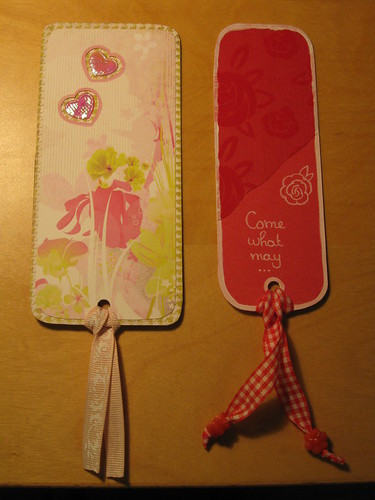
Bookmarks

Is there such a thing as the perfect bookmark? By a show of hands, what’s your favorite? Hmm, well you’re entitled to your preference. For years people have given me these papery trinkets and I have accepted them with a wry grin. I rarely use them. No, I’m not from the doggy-ear school of thought. Shame on you for thinking that.
Technically, I’ll use anything to keep my paperback place. My abridged list includes: napkins, Post-its, bank statements, shoelaces, dry cleaning receipts, broken rubber bands, and oh yeah baseball cards. Baseball cards are my bookmark of choice. I’ve been using them for years.
So you probably suspect that I have some kind of affinity toward baseball and collecting since I have cardboard pics to mess around with. As a kid, I always wanted to be a baseball card dealer. Guess how that panned out? Thhttp://www.blogger.com/img/blank.gife thing is I hate wasting stuff so I put my cards to good use. I’m not saying I am a hoarder by any stretch. At least I’m not as bad as those two clowns E.L Doctorow wrote about.
I’m also not dumb enough to slip a Mickey Mantle between the pages. I generally use a common (that’s a card of so-so value in collecting parlance). Sometimes people on the subway are more intrigued by my bookmark than what I’m reading. They might scan the cover to see if there’s some sort of connection between my reading and marking habits. The jury is still out.
Nowadays though when we hear the word bookmark we tend to think of the tabs we’ve created via our website links. You tag the sites you’ve found htthttp://www.blogger.com/img/blank.gifp://www.blogger.com/img/blank.gifmoshttp://www.blogger.com/img/blank.gift interesting that you DIGG and that you’d like to StumbleUpon again. Managing all of your bookmarks becomes a bit of an art, an exercise in organization. I can always use a bit of help in that category. As far as Kindle is concerned, they have their own modus operandi. Kindle saves your place whenever you put it down, but they also have some new stuff.
Here’s a link to some CNET videos that can give you some suggestions.Kindle Bookmark primer http://cnet.co/eznx5p
When it comes to bookmarking, sometimes I use multiple placeholders. This might be just a quirk on my part. I really haven’t seen anybody doing it, but I bet you a shiny nickel there are bibliophiles among us who do. Care to share and make me feel less self-conscious?
Labels:
Amazon,
Bookmarks,
CNET,
digg,
E.L Doctorow,
Kindle,
mickey mantle,
Paper Cut,
Paper Cut Blog,
stumbleupon
Tuesday, August 10, 2010
Happy One Year Paper Cut

It appears that I missed the official one-year anniversary of my Paper Cup blog. Big Deal. I am back posting it to the official date August 10th not because I am superstitious, but because I feel like I want to make the belated effort. It will make me feel better. Fat chance.
I didn't start my blog to dig into my inner voyeuristic diary, but rather to build a readership. To connect with others who haven't had the pleasure of poking into my notebooks. Yes, I still write by hand. It's sexy. It reminds me that I can only really attempt art with words and not sketches or pictures. I suck at those things.
I'll admit I have been fairly flaky this year with regards to making regular contributions. I am going to try and change that, but I am not making any promises. Promises are for lolligaggers and suckers.
I've also been putting most of my energy into my Girma Dali serialized novel on my wordpress page.
Sorry that this has been such a blah blog, but I suppose it says a little something at least in the subliminal sense of what I truly think of anniversaries.
Labels:
anniversaries,
anniversary,
blah blog,
Girma Dali,
Paper Cut,
Paper Cut Blog
Monday, December 14, 2009
New Gimmick
Don't ask me why but I have decided to include a quirky little section in my blog postings for the rejections I receive from McSweeney's Open Letter To People or Entities Who Are Unlikely to Respond to You. McSweeney's does respond to me, unfortunately they do not accept my entries. So you, dear readers, will get the royal treatment and see my unpublished rejections. Although, since I am posting them on Paper Cut, I guess they will then be considered published. Whatever. The point is, I am sharing my Open Letter To People or Entities Who Are Unlikely to Respond to You. And, should you decide to send them a submission of your own and then have the good fortune of getting it published then please, by all means, let me know. You'll be entitled to a free Inca Cola.
Warm Wishes,
Blogger John
Friday, November 13, 2009
The Waterworks
In preparation for “Homer and Langley” I have decided to tackle E.L Doctorow’s “The Waterworks” first. I’m not a chronological person by nature. In fact, I never read short story collections cover to cover, but skip around because I find that to be more satisfying. I might as well be talking cantaloupes and iPods because there is little, if any, correlation between short stories and novels much less M.O.s for reading them. And, for good measure, there really is no prescribed way to approach an author’s oeuvre.
Actually, I am already familiar with a couple of the chapters from “Homer and Langley” because I recently had the good pleasure of listening to Doctorow read aloud from his newly minted libro. I find the premise, an insider account of the Collier brothers, intriguing although I find the opening “I’m Homer the blind brother,” a bit over-the-top in its attempt to connect with the old world’s storytelling canon. Nonetheless, I have opted to read his mid nineties work about an obsessed newsman.
“The Waterworks” chronicles the life of McIlvaine, a newspaper man and his search for his lost freelancer, Martin Pemberton. That’s the tip of the iceberg. “The Waterworks” is much more than a who done it caper. It’s about seizing ghosts from our past. I imagine, Doctorow’s newsman narrator wincing at the sound of this. He scoffs at the notion of ghosts existing and yet he is plagued by his own ghosts, the papery-thin children hawking papers and flowers in the street and the boy who drowned in the reservoir. Like most Doctorow novels “The Waterworks” flirts with a creative brand of historical fiction. At times, it reads almost as a detective novel as the cantankerous McIlvaine checks in on the missing Pemberton’s fiancée Ms. Tisdale, the lush painter Wheeler, and the Reverend Grimshaw, and so on. McIlvaine is true to his ilk and reports the facts but every once in a while lets on that he is a human being.
There’s something Sinclairian about Doctorow’s novel “The Waterworks” the way the Bronx Bard zeroes in on the inequities caused by the Industrial Revolution. Newsman Mclvaine’s objectivity has a way of unraveling when examining the raggedy paperboys who are responsible for pushing the papers. He describes these “street urchins” and “street rats” as being unremarkable as paving stones.
McIlvaine becomes absorbed in his quest to find Pemberton. It is the confluence of his journalistic acumen and his budding conscience. For me, this is where the story takes off. He develops an affinity for the widow Sarah Pemberton, Martin’s mother, and is enamored by her mothering the youngest boy. This is the flash of McIlvaine’s underbelly— a lightning fast glimmer.
Labels:
Homer and Langley,
iPods,
Paper Cut,
Sinclair,
The Waterworks
Tuesday, October 27, 2009
Ommegang's Three Philosophers
Cooperstown is known for the baseball Hall of Fame, but it also happens to make some great beers too.
Ommegang Brewery, part of the Duvel Belgian empire, is domiciled out there. Great hoppy brew. The one I've been fond of is the Abbey Ale. Tastes like a Trappist treat. Its fruity, nutty, has medium-plus body and is a perfect pair with cheese that bites back.
Recently,I had their Three Philosophers, which is also tangy and tasty. After a big swill your mouth feels like its sucking on fine Ecuadorian cacao with a touch of roasted chestnuts.
If I was forced to say what Three Philosophers this beer brought to mind I'd have to say Kierkegaard, Dewey, and Mo from the Simpson's. I think you'll find it as good good, maybe even better than Chimay's Blue label. Though I've loved that gnarly Belgian in the past my taste buds have been undergoing a transformation lately.
Drink it with a bowl full of nuts and Camembert.
Labels:
beer,
beer factor,
Belgian beer,
cacao,
Chmay,
Cooperstown,
microbrew,
Ommegang,
Paper Cut,
Three Philosophers
Wednesday, October 21, 2009
Chronic City, Jonathan Lethem

At the reading last night, Lethem dispels a haggler who lambastes him for talking ill about Russians by saying "For the paperback, I'll say a few bad things about the Chinese." Lethem has a reputation for being an equal-opportunity-satirist, it's his specialty. He also knows something about scribing kickass prose.
I became I disciple after I read Motherless Brooklyn. I remember going on a junket with a couple of droogies of mine and passing by the Gowanus and saying hey that's where Lionel Essrog tread. Then The Fortress of Solitude became a must read for me. Lethem spins a story of Brooklyn that's full of grittiness and whimsy. How the hell does he do it? Well, he's a King's County man for one and he's an urban anthropologist if this city ever had one.
Chronic City is his latest baby. And it's a beaut. Chronic, just so you know, is top-of-the-line pot, the good shit, the antithesis of schwag. Chase, the former child star, Upper East Side dinner party fixture pals around with Perkus Tooth an oddball highbrow cultural savant. Perkus has this ferocious ability to think elliptically-- he doesn't even know when his synapses clank onto their prescient discoveries.
Chase and Perkus get into some mischief and whatnot. There's a lot of choice verbal barbing. Chase is also in a relationship with a female astronaut who pens letters from outer space. I've seen some critics comment that this book seems more Pynchonian than his earlier works. I see Jonathan Lethem busting out identifying with his Chronic-juked Chase.
The Brooklynite plans to read a different chapter at each of his readings so you could listen to his whole book. In a recession like this, that's a sweet deal on his part. Trouble is you'd have to get yourself to all his events. He got the idea while he was chilling out with some pals in Maine before the novel went into print. Instead of reading to himself, whereupon he might've sluffed through slow parts he put his performance voice in high gear and swigged lot's of honeyed tea.
If you don't feel like pawning yourself as a book groupie or plunking down for the lit gem then I suggest catching a bit of him on podcast. Oh yeah, and Wall Street Journal actually offered a free excerpt. What up with that?
Saturday, October 10, 2009
Why the Snapple Top Makes a Good Substitute for a Fortune Cookie
A Venus flytrap can eat a whole cheeseburger. I learned this fascinating fact #880 from under a Snapple cap. Committing it to memory is not going to stop the Great Recession or save the whales but it got a chuckle out of me. I'm into random musings. Maybe this is why my mind drifts off too far to be a good journalist and I am fiction writer. Maybe I'm a born spin doctor.
I love books where wild sheep chases take place which is why I appreciate Haruki Murakami, Italo Calvino, Thomas Pynchon, Don Delilo, and on. In Veronica Nicolas Christopher's protagonist's whole life changes taking a wrong turn through a hallway. William James calls this stuff the way of the Pathfinder.
Philip Roth notoriously penned a good chunk of his novels from headlines he read out of newspapers. The point I'm driving at is you never know where that glimmer of story, as Pam Houston says, comes from. For me though, I think there is something more. Not to get Cartesian on you, but for me I want to discover an indubitable truth. And in today's world, cobbled from spin, it's no easy task. This is by the way why blogs seem to be spawning healthy, independent lives from the mainstream front.
I still believe a bit in Lincoln's old adage to know 90% of your opponent's argument before forming your own. Something to that extent. And this is why I keep putting various, disparate pieces together in the hope that someday I will have my own Eureka moment.
I love books where wild sheep chases take place which is why I appreciate Haruki Murakami, Italo Calvino, Thomas Pynchon, Don Delilo, and on. In Veronica Nicolas Christopher's protagonist's whole life changes taking a wrong turn through a hallway. William James calls this stuff the way of the Pathfinder.
Philip Roth notoriously penned a good chunk of his novels from headlines he read out of newspapers. The point I'm driving at is you never know where that glimmer of story, as Pam Houston says, comes from. For me though, I think there is something more. Not to get Cartesian on you, but for me I want to discover an indubitable truth. And in today's world, cobbled from spin, it's no easy task. This is by the way why blogs seem to be spawning healthy, independent lives from the mainstream front.
I still believe a bit in Lincoln's old adage to know 90% of your opponent's argument before forming your own. Something to that extent. And this is why I keep putting various, disparate pieces together in the hope that someday I will have my own Eureka moment.
Labels:
blog,
Calvino,
Delilo,
Fortune Cookie,
Murakami,
Paper Cut,
Snapple,
Venus flytrap
Thursday, October 8, 2009
And the Noble Goes to...
Have you read any of Jean-Marie Gustave Le Clézio’s books lately? Hmm. Or maybe you’ve recently picked up 2006 Noble Winner Orphan Pamuk’s Snow.
I don’t want to give the impression that the prize is politically motivated or is a kind of Lifetime Achievement Award, although it does raise brows and draws new readers to the chosen one. Whatever drives new readers is great for literature. To draw to the literary landscape today is a great challenge as we already know. Whatever the motivation to pick up Herta Mueller’s work is well worth it.
I’m a firm believer in expanding the literary landscape. Writing style, subject matter, and rules of syntax lure readers to their favorites, but I’m one who approaches my reading like my wine. I relish a diverse sample. I’m not hung up on Kirkus Reviews, plugs from Slate, or tweets from Salman Rushdie. I read what I read.
Some might consider mine an eclectic, unfocused approach— cherry-picking. I call it stylized discrimination. A healthy lust for poetic memes. But, seriously, I don’t pretend to have the inside dope on all the words, critical and otherwise. I take the Socratic approach, I admit I knowing nothing and work from there.
I am a slow reader and want to experience a book for the work of art it is. In other words, I cannot speed read so I wouldn’t bother reading the plethora of airport fluff. I do take recommendations. I will not pigeonhole everything. I’m a New Yorker, I honor our sacred bird.
So far I know this about our 2009 Noble Laureate. She began her career in 1976 translating for an engineering factory, and was canned in 1979 because she wouldn’t play by the Communist regime’s rules. Herta’s husband Richard Wagner is also a novelist.
I’m not sure if I’ll start with Ms. Mueller’s debut collection Niederungen or Oppressive Tango as I’ve always had a weakness for the Argentine dance. I will make it a point to acquaint myself with her work because I want to expand my reader and writer’s eye.
Tidbit
The Noble Prize in Literature has been awarded since 1901. The only years that no awards for literature have been given are: 1914, 1918, 1935, 1940, 1941, 1942, and 1943.
Labels:
blog,
fiction,
Herta Mueller,
John Gorman,
literature,
Noble Prize,
novels,
Paper Cut
Tuesday, October 6, 2009
A Movable Desk
I’m a mobile scribbler. My movable desk (AKA my lap) finds its way onto buses, planes, trains, and other automobiles. I’ll sit on a rock with my notebook and take stock of the confluence between the world around me and the one passing through my brain.
Yesterday, I decided I needed a real desk. What with my recent move I’ve been typing away on the dining room table. I probably could have kept up for a little while longer, but I’d already been testing my better half’s patience long enough.
My buddy offered me a retro office desk. The thing was as big as a Greyhound. I had no idea where to put it. I needed something simple. Fortunate for me that I live in the neighborhood Furniture Central, Steinway has so many table shops, good stuff, junk, and so-so. You have to have a good eye. The prices are another story. I’m convinced there’s a black hole parked between taste and tacky. Prices not commiserate.
I’m not cheap, but I’m not willing to plunk down a month’s rent for gaudy or impractical. When I veer off onto a side street and see a piece I can imagine in my bedroom/office I poke my head in the shop to inquire on the price. Nobody. I could sweep the desk off the sidewalk and be on my merry way. My bad back is my conscience for the day. I rub my hand over the flat top. Pretty smooth. But, it’s a street model.
A middle-aged man in an ill-fitting fishnet cap and fleshy ears walks to the desk. He has handout written all over his grimy face. I stand my ground.
“Nice desk,” he says.
“It’s ok.”
“How much?” he asks.
“That’s what I’m trying to find out.”
He scratches his fleshy ear and lopes into the shop. At this point, I say to myself you’re not horning in on my desk, bub. When I make it into the shop he is already sidled up to the counter, but there is no attendant to wait on him.
Two can play at that game.
“How much would you pay?’ he asks.
And there’s no way I’ll let him bait me. “You first.”
“Strong pine, last you a long time. Seventy dollars.”
I do a quick mental calculation to make sure I have enough cash on me. My fishnet-hatted foe probably only carries sweaty bills and this place doesn’t look like it takes plastic. When I figure I can beat him by twenty-odd bucks, if the bidding were to go that high, I make a kind of smirk.
Then a skinny kid comes out of the storage room. Finally, we’re going to get a little service around here.
“It come in tan or you like burgundy maybe,” the man says.
“Excuse me?”
“Yuri, go bring burgundy piece for show.”
The skinny kid ducks back into the dusky storage area and then it hits me that this clown is the owner. Somehow I feel more embarrassed for him and the flat beak of his cap that makes me think of a duck-billed dinosaur.
I take two crisp twenties and a crinkled ten out of my pocket.
“Fifty bucks.”
“Strong wood. Yuri carry it for you home and put it together, seventy-five.”
“That’s ok, I can take it myself.”
“Sixty five, we tie it up neat to the roof of your car.”
“I’m walking.”
“You’ll hurt your back.”
“I’ll be fine.”
I take the initiative, put the fifty bucks in his hand. He looks at it briefly as if I’m giving him quarters for the laundry, but then accepts it. Yuri takes his sweat ass time finding the box. They were out of the tan so I settled for the burgundy.
The whole way home, which although wasn’t technically far but it was sure as hell awkward, I reminded myself that I had to put the desk together. And though my back ached, my knees and thighs were bruised from trying to prop the box upright, I had this sweat moment of triumph coming to me. I hadn’t put anything together in as long as I could remember. What better way to get a creative boost than to build my own writing desk.
Labels:
blog,
desks,
furniture,
John Gorman,
Paper Cut,
publishing,
writers,
writing
Monday, October 5, 2009
A Sliver of Turturro
Back in August, I posted about bit players I noticed as guests on sitcoms. This is sort of a hobby of mine, but today I feel compelled to share two minor parts played by John Turturro that I just discovered. I'm a big fan of his work. He covers a wide range: grandmaster chess wonk in Luzhin Defence, pizza parlor primogenitor in Do the Right Thing, newfangled celluloid writer in Barton Fink, Herbie Stempel in Quiz Show.
When I saw Turturro in Desperately Seeking Susan, playing the part of cheeseball MC Ray I was surprised. It's been quite a while since I've seen the film. And, unlike Barton Fink, starring a more mature, painstakingly brooding Turturro the cheeseball MC had a touch of the actor's unmistakable flair. By voice he is recognizable and you can't forget his face.
I also caught a glimpse of him haggling Woody Allen in Hannah and Her Sisters. If you are not acutely attuned the glimpse is missed. It's towards the beginning and during a madcapped scene of merging and diffusing throngs. Turturro plays a young writer who stops Woody for maybe 5 seconds. There's only a peripherally view, but a good shock of John's curly locks.
I did a quick scan to see some other films I haven't seen him in, mainly recent ones. Transformers and Transformers: Revenge of The Fallen. I won't catch either of those though I was nuts about the toys as a kid. But, I might be on a lookout for him on Flight of the Concords or on a Monk rerun. I'd love to see him teamed up with Tony Shalhoub.
Labels:
acting,
Bit Players,
blog,
film,
John Gorman,
John Turturro,
movies,
Paper Cut,
SAG
Friday, October 2, 2009
Pysanky
Pysanky are Ukrainian-stylized eggs. A wax resist method or batik is used to decorate the eggs and a special instrument called the kistka etches the design.
They are usually made for Easter, but folk artists make them all year round. Some have extremely intricate patterns. Most have designs of animals, wheat crops, flowers, trees.
Their origin comes from a myth in which the egg is symbolized as the source of life. Though Christian Ukrainians adopted it by 988 AD (with the rise of Christianity) the pysanky had a long illustrious pagan tradition.
Iryna Bilianska from the Sokol region of Western Ukraine used an embroiery pattern on her pysanky. Hers are more floral-designed than my mom's. My mom made many with deer patterns, trees, and interwoven geometrical shapes. We had a china bowl full of eggs many years ago, but our cat tested her soccer skills with virtually all of the ornaments in that bowl including a few treasures my grandmother had made.
Labels:
blog,
folk art,
John Gorman,
Paper Cut,
pysanky,
Ukrainian Culture
Thursday, October 1, 2009
Helen Levitt
A small tribute to Helen Levitt hangs in the Met’s halls en route to the Contemporary art wing. Her photographs capture the kinetic charm of the city’s urban landscape. There's an influence of documentarian geniuses Cartier-Bresson and Walker Evans although Levitt has less edge, focusing on urban youth in all its free-spirited glory. One of her standout shots is a Mid 40’s picture of two adults and a child stylized into a kind of totem pole. The woman stands tallest has a slack mouth and peers toward the east probably Uptown. The darker-skinned, chunkier man wears a stern look and faces the opposite way. Below him, is a messy-haired child in dreamy, yet frazzled consternation. The boy gapes in the same direction as the woman. His vantage point both physically and chronologically lower may hold the answer to what has grabbed his attention.
Notice the mimetic play of frames within frames in the first shot. The theatricality comes purely from the children (subject's imagination) rather than the artist.
Labels:
blog,
documentary photography,
helen levitt,
John Gorman,
NYC,
Paper Cut,
photography
Sunday, September 27, 2009
Banned Book Week
Don't know how you are celebrating Banned Book Week, which technically kicked off yesterday, but it might be a good idea to explore your subversive side. I am going to pick up a copy of "As I Lay Dying" and "Fahrenheit 451". The former is a Faulkner classic and the latter is Ray Bradbury's tour-de-force that tackles censorship and book-burning.
My interest is of course aesthetic, but I do admit to getting fired up by the notion of reading books that are supposedly inappropriate. I will savor these two literary morsels, but I am not speed-reading to have them completed by week's end. In fact, I just might be adding Ginsburg's "Howl" to the list.
Buena suerte!
Labels:
banned book week,
blog,
book blog,
John Gorman,
novels,
Paper Cut,
publishing
Tuesday, September 22, 2009
Doctorow in the House
During a radio interview the other day, Leonard Lopate described the Collyer brothers as “upper crust packrats” and E.L Doctorow quickly interjected, as he did not like this description. His whole purpose for writing “Homer and Langley” was to breathe new life into the Collyer’s story. Whereas so many of their past accounts have gone into excruciating detail over their death, Doctorow celebrates their life, has elevated their status into the mythic realm. What struck him as horrific were the police reports from the 40s, how they hacked their way into the townhouse. Such vilification needed a human touch. Doctorow has always taken his well-earned poetic license along with him into his historical fiction forays and many critics are calling this one of his masterpieces.
I had the good fortune of watching him read the other night at Book Court, in Brooklyn Heights. Doctorow stood at the podium like a poet from a bygone era, delivering a lodestar of a eulogy. He bore a certain resemblance to Craig Lesley as he read. He started by saying that Brooklyn was a great place to give a reading with its rich tradition of scribes. “The Bronx,” Doctorow said, “Only has three of us writers that I know of: Dom Delillo, Richard Price, and me.”
He has a pleasant cantankerous quality about him like the know-it-all uncle waiting to share his treasure trove of knowledge if you are patient enough to bear with his circumspect delivery. He admitted that the end of the book crept up on him one day. He looked it over, hmmed to himself, and declared the story wouldn’t run any further. He got up from his desk, went over to the bar, poured himself a stiff drink, and celebrated.
When asked if he had done any research on the Collyer brothers he admitted to checking out a few pictures, but he didn’t want to pollute his head with facts and so opted for the mythic route. The opening line came to him, seemingly from out of nowhere, “I’m Homer the blind brother.” In the Lopate interview, the radio wonk was quick to point out to Doctorow how Homeric the sentence is and yet Doctorow didn’t even realize until he was halfway into the book. Great writers tend to bring the enterprise of literature into their own writerly junkets. The trick is to artistically pilfer so that your style shines through it.
In the past, he has also been chastised for stretching the boundaries of history to suit the needs of his narrative. But, let me just make this point clear, he is a fiction writer.
Hollywood has no problem demolishing the foundation of his stories to suit their needs. Ah, but that’s not the same as delving into history fiction. There needs to be some degree of verisimilitude. Sure but, what Doctorow is doing is taking an almost fabulist strand and running with it. Once upon a time, Dickens’ novels told a greater truth of the old England than the history books of its time and what about “A Connecticut Yankee in King Arthur’s Court”. Am I creating a fallacy of slippery slope? Maybe. I just get tired of hearing idiotic gripes when the total effect of the work— its literary gestalt— should be the chief nugget of artistic evaluation. The words my friend, look to the words.
I am going to trust the scribe who depicts his reclusive anti-hero with “Lisztian hair” and can come up with a novel way for driving a Ford Model T into the living room. Leave the biographical notes for the academic journal.
Labels:
blog,
E.L Doctorow,
John Gorman,
leonard lopate,
local authors,
Paper Cut,
readings
Subscribe to:
Posts (Atom)