Wednesday, April 20, 2011

Interview With Carolyn Arnold

Today my guest is the writer Carolyn Arnold. She’s the author of 6 novels and is currently completing her 7th novel entitled Eleven. Carolyn is also the founder, publisher, and author of the blog A Writer’s Journey.


JG: You recently had an amazing post about determining body temperature at the time of death. What kind of research did you do to find this out?

CA: The internet is an amazing wealth of information. Of course, you can’t take everything you read as credit worthy. That’s why I cross-reference the material to ensure the accuracy of what I’m trying to share with the followers, and viewers of my blog. I also suggest any M/T/S (mystery/thriller/suspense) writer get the book Howdunit Forensics A Guide for Writers.

JG: Who are some of your favorite writers?

CA: Love David Baldacci, and Sandra Brown. Other authors I have enjoyed reading are Lisa Unger, John Gilstrap, and Jonathan Kellerman to mention a few.

JG: What turns you off?

CA: Inaccuracies or inconsistencies. If you’re going to write a novel, make sure you know your facts. As writers, we’re reminded that our readers are more educated than ever, and we wouldn’t want to disappoint them. Even keeping in mind that some of our readers may get their education from “Hollywood”, as writers we are entrusted with the privilege to get the facts right. So, if something we present in our work may contradict what they watched on TV, but it’s factual – always go with the factual.

JG: Why did you decide to start a blog?

CA: At the point I started the blog, I was editing. I find the process of editing, although rewarding, to be even more solitary than writing itself. I thought by writing blog posts this would fill the need to get words “out there”. What it became was much more. I opened the blog to guest posters, and found that by getting fresh perspectives I learned from them, and became inspired by them.

I believe that as writers we’re stronger united, and banded together, than we are alone. I also strive to be creative, and unique with the subject matter I decide to discuss. This is how Forensic Friday, The Human Observation Project, and Writing Weekend posts were born.

JG: Are you working on anything special right now? Any assignments, novels, query letters

CA: Right now, I’m working on finishing my seventh novel. ELEVEN is a thriller that follows a FBI team in search of a serial killer. When they think they have everything figured out, it’s almost too late when they realize they don’t.

I’m also working on finalizing edits for my other novels, and getting them ready for agent query. And of course, I’m doing all this while working full-time.

JG: If you had your druthers, would you prefer publishing a story online or in a print magazine?

CA: I’m going to go with print. And this is for two reasons: 1) I love the feeling of holding what I read in my hands, and would love to hold my work, and 2) isn’t everything, even printed work available online at some point? :)

JG: Self-publishing or Traditional?

CA: I praise anyone who gets their work into print, and hold respect for those who choose to self-publish. For myself though, at this point, I still have untapped opportunities that I’d like to pursue in the traditional publishing arena.

JG: Who are your writing influences?

CA: Influences, or support system? Inside, I believe I was meant to write. Now, maybe this sounds absurd, but at this point, it’s what I believe. As far as a support system, I’m thankful to say that I live with my best friend, and largest supporter.

JG: Why do you believe you were meant to write?

CA: I used to write as a way of expressing myself as a teenager. As life went on, I got married, and everything significantly changed. I didn’t even think of writing anymore other than the passing thought “it would be neat to write a novel”, and even then, it didn’t come up often.

But about four years ago now, a situation arose where a co-worker asked me to tell her a story. Work was uncertain at the time, and we knew that the Head Office would be coming in and laying off the department basically any day. So, I emailed her the first two paragraphs of a story, that just “came to me”. She kept wanting more, and then told me I had to finish. By then, I was wrapped up in the characters, and the excitement of writing again so it wasn’t a problem. A year later, I had completed my first novel.

I believe if you come back around to something in your life, it tells you something. I have since written 6 novels, with my 7th in the works.

JG: How long does it normally take you to complete a first draft of a novel?

CA: My first took me about a year, the second six months, the third three, and then my fourth, fifth, and sixth novels anywhere from one to two months each.

JG: What are you reading now?

CA: True Blue by David Baldacci.

JG: What's your daily writing routine like?

CA: I wake up about six during the work week to a cup a coffee and my laptop. I find the early mornings to be the most productive time for writing. I also bring my laptop to the day job and work on my writing during my lunch (but it’s only half an hour). At night, I work on posts for my blog. Weekends – while they’re like the “promised land”.

JG: What’s your favorite place to hang out?

CA: Honestly? My media room. We’ve got it set up with a large screen TV, and surround sound. There’s a sixteen-foot bar down there too. What more can I say?

JG: Favorite Bookshop

CA: It has to be Chapters. You can’t go wrong with Starbucks in there too!

JG: The 5 most important books you’ve always wanted to read, but still haven’t gotten around to.

CA: Wow, this is a tough question. I guess I don’t give a lot of thought to what I’m reading that far ahead. I know there’s a few from writers I’ve met online that I would love to support.

JG: Plot or character?

CA: You mean, which is more important? That’s a tough question. I believe the two are required to make a solid book. While characters drive the plot of the novel, you also need a plot to lead the characters along their journey.

JG: Any words of wisdom you’d like to share?

CA: Keep writing. Even on days you don’t feel like it, make yourself. You’ll be amazed what comes out onto the page. And as you keep writing, you’ll learn and grow. Another key aspect of growing as a writer is to read. Read other books in your genre, read out of your genre, read books on the craft. But on the latter, I’m placing a disclaimer. Books on the craft can be incredibly useful, but don’t take them as rule books, view them as suggestive guidelines.

Open yourself up to criticism. It’s tough, and sometimes it can sting, but you’ll grow from it.

Another thing, reach out to other writers. Whether this comes in the form of an online community, one in your neighborhood, a blog, or Twitter – connect.


Brief Bio: Carolyn Arnold was born in 1976 in the rural town of Picton, Ontario. Currently she lives with her husband of fifteen years and her two beagles in a city about two hours from the well-known Canadian center, Toronto.

While her first completed novel was a romantic suspense, since then she has branched out to the mystery, suspense and thriller genres. Her goal is to become a well-known writer, and a mentor for others striving to reach their publishing dreams.


You can follow her on her blog here. Also on Twitter here.

Tuesday, April 19, 2011

Flex Your Flash Fiction Muscles


It’s long been said that a failed poet is a short story writer. That’s a bit of a stretch if you asked me, but maybe I feel that way because I’m a wee bit jealous of the poets and I keep scrapping out short stories. Lately though I’ve been noodling with flash fiction. It’s a great way to map out a plethora of ideas and not have to worry about “going poetry”. I’ve been doing this for a while now. You already may have noticed that Flash Fiction as a style of writing has been growing by bionic leaps.

Flash Fiction seems the appropriate medium in our Attention Deficit Age. More and more journals are offering readers bite-sized portions of prose. Today more writers are dabbling in the various mediums to perfect their craft, but also to connect with readers. Many of us have less and less time on our hands because of work, family, YouTube or gaming habits.

Anybody who writes should practice the art of Flash Fiction because the medium helps you focus on being concise, weighing words, and delivering sweet brilliance. You’ll discover that words carry more than meaning. They own their own shape. When I engage in micro-writing exercises, I approach it like woodcarving. I know absolutely zilch about woodcarving, but I imagine that shaving off excess wood is similar to finding the right words and placing them in the right nook of the sentence.

Sometimes it takes a month or two or nine to write a really good short story and many of us may not be invested enough in our characters to take that much time. What’s the solution to our creative quandary? Drop it altogether? Not a chance. Pick an idea or two and give yourself a page’s worth of free writing. See where your stream of consciousness takes you and then you can go back and let the left brain do its analytical stuff.

When you whip up something that you think meets the taste test you’ll be happy to know there are many online and print Zines dedicated to Micro Fiction. Some Zines are exclusively devoted to Micro Fiction: Smokelong Quarterly, Flashquake, Quick Fiction, and Brevity. Boston Literary Magazine focuses primarily on flash fiction, but further distills its passion by offering 250 words (or less), Drabbles (exactly 100 words) and Dribbles (exactly 50 words). The people behind Smokelong named their journal because one can smoke a cigarette while reading a single prose piece. Non smokers will be happy to note you can gobble down a Ring Ding while fully digesting a story.

Robin Stratton, the editor-and-chief of Boston Literary Magazine, has been doing great things with her journal and they are currently taking submissions for their upcoming issues. You can find out more about them by clicking here.

The consummate flash fiction artist keeps climbing the literary ladder. The Micro Award was established in 2007 to distinguish the work of brief brilliance. Kevin Couture is already this year’s winner. His piece “Choosing a Photograph for Mother's Obituary” appeared in the Antigonish Review.

It won’t be long before that old adage about poets and failed short story writers gets tweaked and short story writers are considered failed Flash Fiction writers. It’s a slippery slope out there. You better find your footing fast.

Friday, April 15, 2011

Let Them Toot Your Horn


Nobody lusts to be Wilson Betemit or Kosuke Fukudome. Everybody wants to be Albert Pujols, A-Rod or Josh Hamilton. Hell yeah. They’re all pro ball players, but there’s only so much room on top.

In terms of emulating, it pays to learn from top dogs. No argument there. All the same, a lead into how the middling athlete makes it to “The Show” can lend a clue to the would-be Best Seller in the right direction.


Here’s where you need to take notes. Discipline and consistency are the make or break factors. Pujols, A-Rod, and Hamilton don’t necessarily take more cuts in BP (Batting Practice), but they might if they are in a slump. What separates them from the platoon and the pedestrian players is that sanguineous desire to make each cut count. They know their strengths and when they see a ball in their zone— WHAM— they rip it.

I’m getting the point. Writers need to think like All Star Sluggers and figure out their pitch zone. You’re not always going to hit a homer, but if you know your strengths you will hit the ball with authority. Translation: Your focus on production will drive results.

If you’ll permit me to leap from Top Dog to Top Down thinking you need to consider the zealous, undisciplined approach to book promotion. So you want to be the next Barry Eisler, John Grisham or John Irving. Wanting is not enough. Wannabes are a dime a dozen. Results-driven writers— whoa, that’s something.

Okay, you’ve completed a great manuscript. The galleys cut the mustard and the publisher gives you the green light. Your graphic designer has whipped up something bad-ass. You can see your book in Borders and B & N windows, you’re pumped for a book tour, psyched to sign autographs and sip Evian from recycled plastic while you wait the applause to die down as you stand by your podium, microphone clipped to your linen collar. You’ve been waiting for this moment— forever. And, best of all your book has universal appeal. It’s a Techno-thriller with zombies, pitchforks, spiritual gurus, and you’ve even managed to sneak a few yum yum recipes on the inside flap of the book jacket. The story takes place in the 1980s so it’s got Historical Fiction appeal.

Grand slam!

Ahem. Who does this book really, really appeal to? If you had to pencil-sketch your reader who would he or she be? What book clubs does she belong to? What hobbies does he have? If your reader was a snack food what type would she be? You see where this is going. The whole wide world ain’t your audience. Not yet. They don’t even know who you are or that you prefer Twizzlers to Skittles.

The homework assignment is to go to a café or some public place where readers chill. Chit-chat with somebody, ask them why they are reading what they are reading and tell them how much you’re enjoying David Bezmozgis’s new book. Will this launch you to stardom? Not a chance, but it will get the wheels turning in the old brain. You meet enough bookworms and find out what excites them and what kind of people will DiGG your stuff and you might find yourself rising up Amazon faster than you can say Red Hot Chili Peppers.

Wednesday, April 13, 2011

Hey Bub, You're Not Cutting This Line


Sometime ago, what’s the difference how far back, I had the notion I’d share Cheetos with Stephen King, crack a beer with Malcolm Gladwell, dance the tango with Joyce Carol Oates. Newsflash. In your dreams. My dreams weren’t even so kind. I’ll admit I used to go to a slew of readings and book signings hoping to become BFFs with the Hardcover Crew, but time again I was nudged to the side like a schlemiel being denied his bowl of mulligatawny by the Soup Nazi.

Okay, Best Sellers aren’t the Soup Nazi. Maybe their agents and pouting publicists are. What I’m trying to say is that no matter how many times I tried bellying up to these Scribe Stars they kept putting up their shield. I’d do the same thing in their shoes.

A little role reversal maestro. In all fairness to them, I went about my schmoozing as a real dink. Authors are constantly barraged. They're propositioned by a gazillion schlubs. You think some smarty pants hasn’t tried slipping them a manuscript on the sly?

The nicest Lit Luminary I ever met was Myla Goldberg, Bee Season. I approached her at the Brooklyn Book Festival in 2009. She was very down-to-earth and a generous chit-chatter to boot. Even after the panel discussion had ended, she had no problem gabbing about books, her influences as a writer, and favorite snacks. How awesome I thought, to be gabbing so calmly with somebody who collects Hollywood royalty checks.

As great as it was to have had the opportunity to chew on her ear for an hour or so it didn’t help me sell one book of my own. We’re not BFFs. I don’t have any contact information from her, but her agent’s. That’s fine. I get it. Sure now I get it. But, the idea of rubbing elbows with Best Sellers and letting their lady luck rub off on me was silly at best. We should never think they are better than us, but I went about cultivating my following the wrong way.

Connect with the reader. I would have been 100 times better off chatting with the rest of the crowd, the Regular Joes and Janes. I’ve since learned to build relationships with readers, those who might actually pick up my book. It’s not about prejudging and excluding readers. Anybody could be your reader, but be realistic about who your target audience is and if you do your job and word spreads, always let the curious cut your line.

Monday, April 11, 2011

Bookmarks


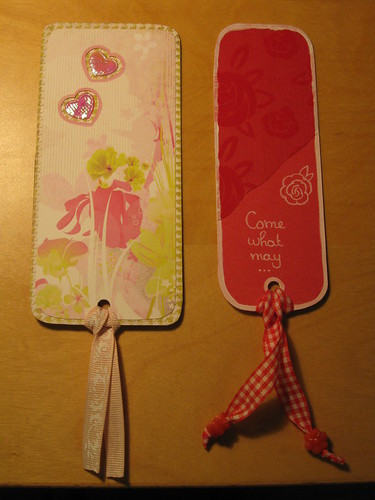
Is there such a thing as the perfect bookmark? By a show of hands, what’s your favorite? Hmm, well you’re entitled to your preference. For years people have given me these papery trinkets and I have accepted them with a wry grin. I rarely use them. No, I’m not from the doggy-ear school of thought. Shame on you for thinking that.

Technically, I’ll use anything to keep my paperback place. My abridged list includes: napkins, Post-its, bank statements, shoelaces, dry cleaning receipts, broken rubber bands, and oh yeah baseball cards. Baseball cards are my bookmark of choice. I’ve been using them for years.

So you probably suspect that I have some kind of affinity toward baseball and collecting since I have cardboard pics to mess around with. As a kid, I always wanted to be a baseball card dealer. Guess how that panned out? Thhttp://www.blogger.com/img/blank.gife thing is I hate wasting stuff so I put my cards to good use. I’m not saying I am a hoarder by any stretch. At least I’m not as bad as those two clowns E.L Doctorow wrote about.

I’m also not dumb enough to slip a Mickey Mantle between the pages. I generally use a common (that’s a card of so-so value in collecting parlance). Sometimes people on the subway are more intrigued by my bookmark than what I’m reading. They might scan the cover to see if there’s some sort of connection between my reading and marking habits. The jury is still out.

Nowadays though when we hear the word bookmark we tend to think of the tabs we’ve created via our website links. You tag the sites you’ve found htthttp://www.blogger.com/img/blank.gifp://www.blogger.com/img/blank.gifmoshttp://www.blogger.com/img/blank.gift interesting that you DIGG and that you’d like to StumbleUpon again. Managing all of your bookmarks becomes a bit of an art, an exercise in organization. I can always use a bit of help in that category. As far as Kindle is concerned, they have their own modus operandi. Kindle saves your place whenever you put it down, but they also have some new stuff.

Here’s a link to some CNET videos that can give you some suggestions.Kindle Bookmark primer http://cnet.co/eznx5p

When it comes to bookmarking, sometimes I use multiple placeholders. This might be just a quirk on my part. I really haven’t seen anybody doing it, but I bet you a shiny nickel there are bibliophiles among us who do. Care to share and make me feel less self-conscious?


Tuesday, August 10, 2010

Happy One Year Paper Cut


It appears that I missed the official one-year anniversary of my Paper Cup blog. Big Deal. I am back posting it to the official date August 10th not because I am superstitious, but because I feel like I want to make the belated effort. It will make me feel better. Fat chance.

I didn't start my blog to dig into my inner voyeuristic diary, but rather to build a readership. To connect with others who haven't had the pleasure of poking into my notebooks. Yes, I still write by hand. It's sexy. It reminds me that I can only really attempt art with words and not sketches or pictures. I suck at those things.

I'll admit I have been fairly flaky this year with regards to making regular contributions. I am going to try and change that, but I am not making any promises. Promises are for lolligaggers and suckers.

I've also been putting most of my energy into my Girma Dali serialized novel on my wordpress page.

Sorry that this has been such a blah blog, but I suppose it says a little something at least in the subliminal sense of what I truly think of anniversaries.

Sunday, July 11, 2010

The Birth of Girma Dali


Okay, it's been a mondo long time since my last post. I can admit it when I've been slacking off, but I've been working on a special project and now I'd like to share it with you. So far I have promoted Paper Cut as multifaceted arts blog and included interviews with writers and covered a wide range of topics. Today, I want to plug my new serialized novel Girma Dali which I launched in honor of this 2010 World Cup. The inspiration for this novel is as diverse as my interest in general.

Girma Dali is a one of kind football star who leads his underdog squad The Harambee Stars of Kenya into the World Cup Group Stage. He has gained great respect of his fellow players, fans, and world leaders alike because he is gifted with the ball, but also because he appears to be somebody who can bring peace to the world. Diplomats, senior officials, and political leaders want Girma Dali to use his cultural, motivational, and bargaining capital to stop the bloodshed in his nation and throughout the African continent. Dali rises to the occasion and goes where he is needed. When he learns that his best friend from childhood, who he met while he was living in Kibera, might have fallen into the captivity of an unscrupulous warlord Dali all but falls apart. He promises to save his best friend Benga, but has nowhere to turn.

Girma Dali is a sports novel, an adventure novel, and in a way, a platonic love story. Girma Dali is about brotherhood, family, pride. Deep at its core it is about reconciliation, hope, and the unwavering burden of personal gratitude.

Here is an excerpt.


Amid the swerve and pulse of hungry bodies Girma Dali picks his spot, a tissue-wide patch of net where’s he going to strike. A green-jerseyed defender closes in on him his brute momentum unleashed like a kamikaze pilot swooping into enemy orbit, his lunging body makes Dali cut the other way. After the defender has crashed, Dali has already made another charge, the pull-weight of his monster calves bring him within a sharp angle of the far post. Chalk and turf shoot from his hurried spikes. A rip of adrenaline carries through his thighs up his tall spine his arms pinch in at the elbows calm as old men napping in a hammock. His round wet bold, green eyes, more than anything else, lust for the back of the net. If only that would settle it, there are pyrotechnics rumbling in his gut firing signals to his brain mirroring back all the hardships, sacrifice, how he slipped free by the skin of his teeth and the ball waits before him a microcosm of his life, a crucible of his self-worth, he’d loved to sock the cover off, but its wound too well in his brain.

Sweat beads furiously down his flushed cheeks. He scrambles. A nervous tick clamps hold of his motor skills bites into him like senseless bacteria attacking an innocent host. He’s careful, oh so brilliantly careful with his touch, sending a fake signal left and takes a meek chip right. The boot stopped by the goalkeeper. And just like that the cheers of some eighty odd thousand stadium fans, billions worldwide, whisk to a hush. The goalkeeper hurls the ball to his punchy defender. Life is good for a few more seconds, but at any moment, the ball is intercepted and the hopes and dreams of nations blow away like so much chalk dust.

Football is a game for legs and hearts. Girma Dali has put his soul into the game. He flies through defenders like he’s got wings, his ferocious instinct makes him both feared and loved. He plays with breathtaking fluidity you feel like weeping. The moment somebody thinks they’ve nailed the grand alchemy that makes Dali a genius somebody else came along and offers a new, kookier explanation. All agree Dali is a god in cleats.

He broke onto the international stage, seemingly out of nowhere, and arrived by accident. He played for a string of so-so clubs mainly in the MLS then landed a spot in the Japanese League. He never scored more than three goals in a single season. For five years, he had blown his national team tryouts. Last Spring an outbreak of a mysterious influenza knocked three men off the roster and in a desperate need of a warm, healthy body his name was penciled in. The Harambee Stars needed speed, discipline, a better coach, mental toughness, a goalie who didn’t suffer from narcolepsy— they would’ve settled for one decent chipper whose committed work ethic might rub off on them. They were also kind of lazy. Coach Sangaré had flip-flopped the players’ positions numerous times sure the winning combination was only a shuffle away. The whole while, the great spark, Girma Dali hugged the bench his wide green eyes gobsmacked at the streams of screaming fans that filled the stadium. He’d never seen so many people staring back at him, well, maybe not exactly at him since he was riding the bench, but at the players tearing up the sun-baked field.

The breakthrough game happened to be a friendly against Paraguay, three years ago to the day, when Moussa M’bami sprained his ankle and later Ken Ogolla was thrown out of the game for squeezing the referee’s nipple. The Harambee Stars had bled through their whole roster save for the bright-eyed and jittery Girma Dali.

Coach Sangaré pointed at his last bench man the slouching Dali in his spotless white visitor’s uniform, picking at grass. He had no idea he was being summoned into the game. He froze for an instant staring at a grass sprig wedged under his thumbnail. The Coach’s bearded neck swelled, his nostrils flared, and he rushed Dali as if a manic rhino about to gore a snoozing poacher.

“Get in there,” Coach Sangaré yelled waving his stubby finger.

Girma Dali snapped out of his funk. He ran so fast he zipped out of his shoe. The battered leather lump tumbled end over end with its laces tangled until it stopped to lay on its side, in the middle of the field like a spoiled child waiting to be scooped up by its parent. The other team snickered. Nobody had seen anything so ridiculous. They couldn’t stop laughing, Paraguay’s star forward nearly split his gut, but this didn’t seem to bother Girma Dali who had waited his whole life for this golden opportunity and didn’t bother to put back on his shoe. Big deal, as a kid he’d played many games in the street barefoot. There he honed his craft, his toes long since callused he could play on the side of a mountain, on top of a volcano. He was filled with the same ebullient desire from his youth.

The rest of the game the shoeless Girma Dali hustled with unparalleled zeal. He dashed with feverish glee, a crinkle of a smile splayed on his cool pink lips. In less than sixty seconds, he made his first touch with his shoeless foot. He dribbled to the outside past one then two defenders his ability to switch gears, midfield, left to right was marked by his almost rubbery legs bending at his whim. What looked like a hard pass turned out to be a fake, a short drift to the outside of the defender and Dali caught up to the ball then advanced a few yards from the box. When he ditched the last man he saw the lone Guaraníes’ goalkeeper who was no longer laughing. Dali struck and was blocked. The goalkeeper cleared the ball and precipitated the race to the other end. Dali owned a few slick moves. He replayed the opposing team’s gossipy cackling as he ran the length of the field with the growing urge to prove himself. When he crossed paths with his unlaced shoe he didn’t stoop to retrieve it instead he kicked it past the foul line. This had his teammates, his coach, and the fans shaking their heads. His opponents howled not so much because they found him to be a joker, but because they thought he was nuts. Good, Dali thought. Let them think it. He carried on, majesty, Merlin, merrymaker with the ball. Everybody who had ever doubted his abilities stood before him, an angry phalanx of cacklers, he sped past them putting on what would later be dubbed “the exhibition” full of corner kicks, spirited tackles, and magic.

He did not make a single goal that game, but he was credited with a steal and two assists. His stock shot up in Coach Sangaré’s eyes and the coach told the press that he had a secret weapon in Dali.

The next game he played with both his shoes. They didn’t come off his feet. He didn’t even bother to give his laces a tug. River Plate double teamed him and for the first half this seemed to do the trick in neutralizing the Harambee Stars’ scoring drives. Dali managed to stay hungry on defense making a couple of steals, but when he ran in offensive mode he lost a step. His kicks skittered, didn’t have the same teeth they had in his first game.

They were already in stoppage time when Dali squeezed into the penalty box tip-tapped the ball luring the goalie to the right and then booted it by him on the left. The game ended in a tie, but it was a sweet victory. The stadium erupted. It was astonishing to have such thunderous applause for the visiting Kenyans, but really there were many Boca Juniors fans on hand rooting against their most hated rival, River Plate. For fun, one of his teammates had decided to kick off his shoes. Then another and another until the whole team scampered around in socks.

Coach Sangaré eyed his players, but you could almost tell he’d been itching to join.

When the Harambee Stars matched up with the European squads they held their own. First, Czech Republican then Netherlands, Greece, and Ireland all of the matches fought hard. Dali got better each time out. His passes launched with stealth accuracy and he seemed just as happy to let his teammates take the goal or to drop back on defense and tangle with his opponents. The siren sound of the bench, a frightening ring, he’d always seemed to hear these things his will would not let him fall not now he’d come too far and so fast. The World Cup seemed an eternity away and yet it also felt a day away it was the perfect anomaly summing up Girma Dali’s life things that should have been out of his reach suddenly came into tow. Yes, he’d had luck. Do you want to call it that? He owed a little to chance and didn’t give himself enough credit. In Dali’s eyes nested the ever-looming sense of debt.

To read more please check out:
http://girmadali.wordpress.com/